Supporting you to make a decision
Risks of induction of labour
Risks for mother
Medical intervention:
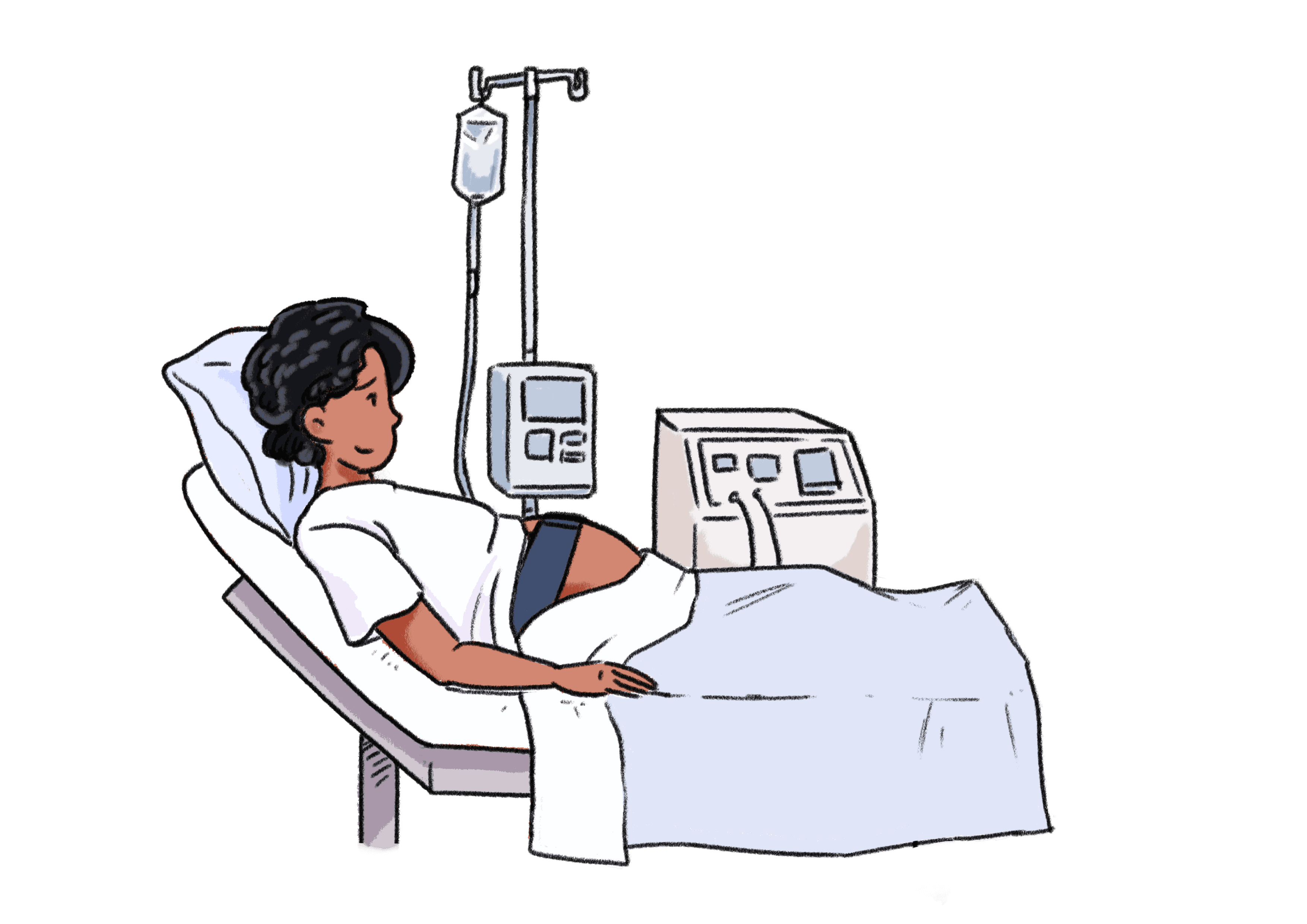
Induction of labour is a medical intervention that will have an impact on your experience.
Examinations
You will need to have vaginal examinations to assess the cervix. These are needed before and during induction, to support decision making and monitor progress.
Place of birth
Your choice of where to give birth will be more limited, as inductions are not routinely available for home birth or in midwife-led birth units. There may be limitations on the use of a birthing pool too. Please speak to your team.
Pain
An induced labour may be more painful than a spontaneous labour.
Cervical ripening methods (membrane sweeping, vaginal medication and mechanical methods) can cause pain and discomfort. Sometimes there is a small amount of vaginal bleeding when carried out/inserted.
Length of hospital stay
Your hospital stay is likely to be longer compared to if you go into labour spontaneously.
Outpatient vs inpatient
If you have the first part of induction at home (outpatient induction), we won’t monitor your observations and your baby’s heart rate as frequently as if you were an inpatient. There is therefore a small chance of us not detecting a problem while you’re at home.
Effectiveness
There is a chance that you may not go into active labour.
Heavy bleeding
You may have heavy bleeding after birth (postpartum haemorrhage). This is an emergency and will be managed by the obstetric team by monitoring your vital signs, giving you medications, fluids and examinations. If it doesn’t settle you may need to go to theatre.
Infection in your womb
If your labour is longer than usual, or your waters broke before labour there is a higher chance of you developing an infection in your womb (chorioamnionitis). This would usually be treated with antibiotics, and your doctor may suggest that the birth of your baby should be by caesarean or instrumental birth.
Severe perineal tears
Increased chance if you have an instrumental birth.
Risks for baby
Fetal Distress
Using medication to start your induction and/or the hormone drip (Oxytocin) causes your uterus to contract. Sometimes babies don’t like this. This can also happen if your uterus to contracts too frequently or contractions last too long. Fetal distress means we cannot be sure that the baby is getting (or will carry on getting) enough oxygen. We usually stop the medicine and can also give an injection to stop contractions. If the heart rate does not improve, we will recommend an emergency caesarean birth, even if it does improve, it may be that your doctor discusses this option with you anyway.
Infection
Once your waters are broken (amniotomy), you can choose to start the hormone drip immediately, delay starting this or can choose not to have it at all. Delaying or choosing not to use the hormone drip may mean that your labour takes longer, and there is an increased risk of infection in your baby.
Risks in specific situations
Previous caesarean birth
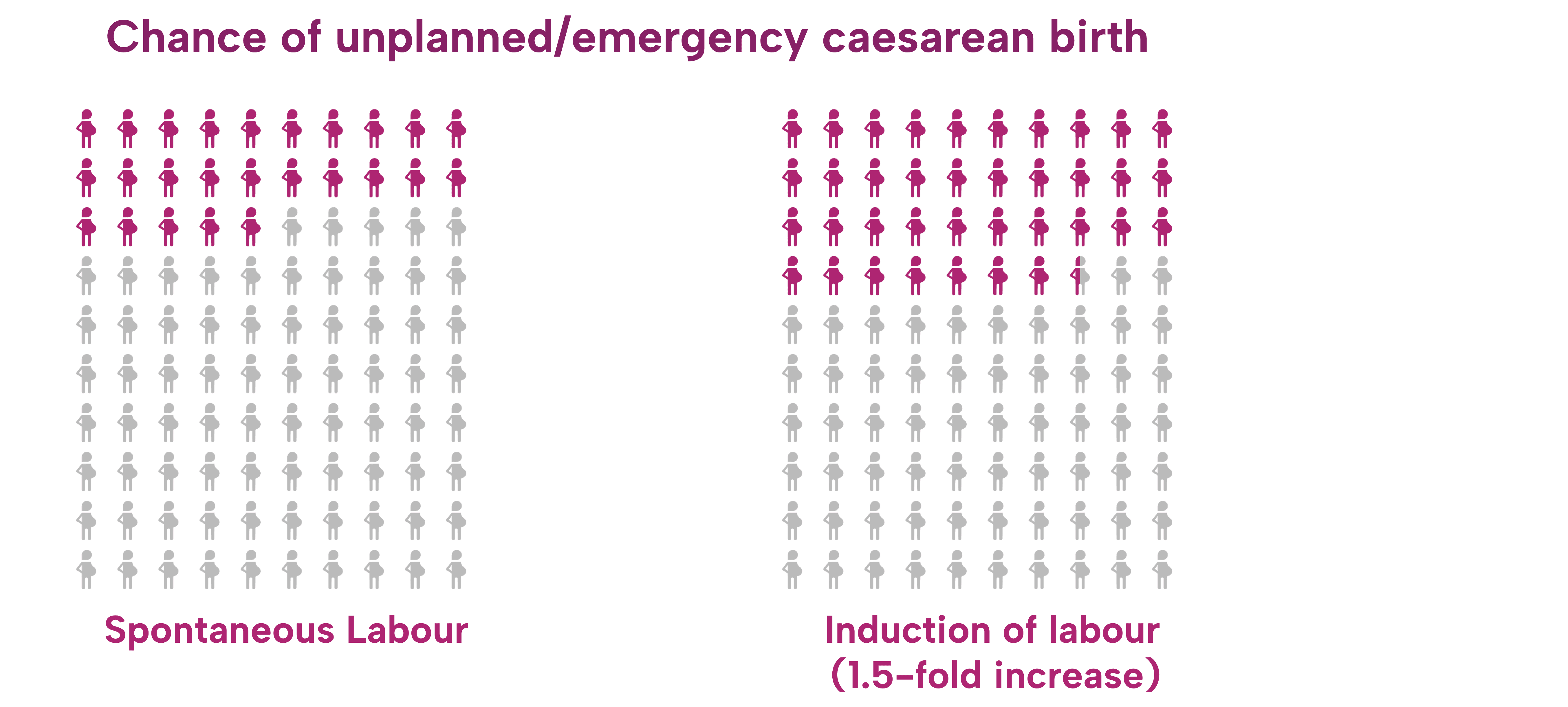
Induction of labour increases your chance of unplanned, or emergency caesarean birth compared with those that have spontaneous labour without induction. The chance goes from around 25 in 100 to 37.5 in 100 (1.5-fold increase):
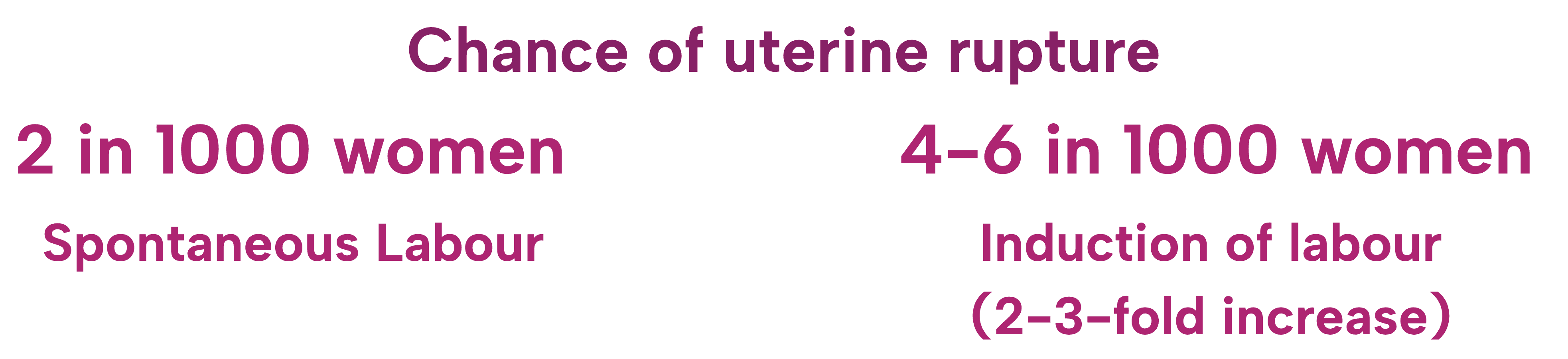
The chance of uterine rupture (the scar on your uterus coming apart) is increased if you have an induction of labour compared to those who go through labour without induction or the use of oxytocin. This risk goes from around 2 in 1,000 to 4-6 in 1,000 (2-3-fold increased risk).
If your baby is large for gestational age.
This is where your baby is thought to be big on ultrasound scan. There is a higher chance that your baby will need phototherapy (light therapy) for jaundice (baby’s skin looking yellow).
Possible delays during the process:
Your induction of labour will take some time. How long will depend on what method of induction is available to you, how your body responds, and how busy your local unit is at the time. There may be delays before starting your induction, or between the different parts of your induction. You need to be prepared for the process to take a couple of days before being transferred to the labour ward.
Your maternity unit will only start your induction when there is enough staff to take care of you. Inductions will take place according to their clinical urgency.
Once the medicines/device has worked there may be a delay transferring you to the delivery suite to have your waters broken (amniotomy) as there needs to be a midwife to take care of you during your labour. Once you have given birth, you many need to wait until a bed is available on the postnatal ward.
Once you’re ready to go home, may be a wait for you to be discharged. Your midwife may be taking care of several women/birthing people and there is a lot of paperwork to complete. The team will discharge you as soon as they can, but there may be a wait for your discharge medication from pharmacy.